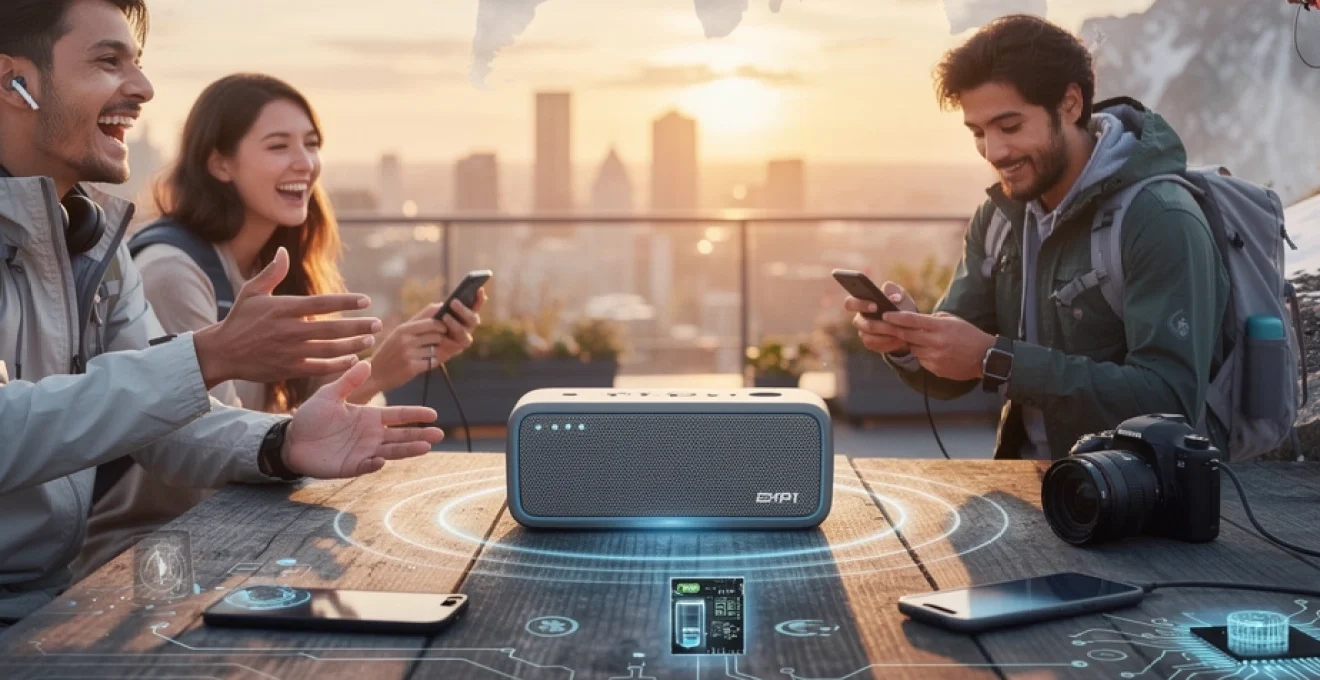
Modern travel has evolved far beyond the days of bulky boom boxes and tangled earphone cables. Today’s discerning travellers demand audio solutions that match their adventurous lifestyles, delivering exceptional sound quality while withstanding the rigours of constant movement. Travel speakers have become essential companions for explorers, business travellers, and leisure seekers alike, transforming ordinary journeys into immersive audio experiences.
The technology behind contemporary travel speakers represents a convergence of acoustic engineering, power management innovation, and connectivity solutions. These compact devices must balance competing demands: delivering rich, powerful sound whilst maintaining portability, surviving environmental challenges while preserving battery life, and providing seamless connectivity across diverse technological ecosystems. Understanding the sophisticated engineering that makes this possible reveals why choosing the right travel speaker can fundamentally enhance your journey.
Whether you’re creating ambience in a remote camping location, sharing music during a beach gathering, or maintaining productivity during extended business trips, the right travel speaker becomes an integral part of your travel toolkit. The following exploration delves into the technical sophistication that transforms these compact devices into powerful audio companions.
Bluetooth codec technologies and wireless audio performance in travel speakers
The foundation of any exceptional travel speaker lies in its wireless connectivity capabilities. Modern Bluetooth codec technologies determine not only the quality of audio transmission but also the stability and reliability of connections across challenging travel environments. Understanding these technologies helps travellers make informed decisions about their audio equipment investments.
Aptx and LDAC codec implementation for High-Fidelity sound transmission
Advanced Bluetooth codecs represent the cutting edge of wireless audio transmission. The aptX codec family, including aptX HD and aptX Adaptive variants, enables near-lossless audio transmission over Bluetooth connections. These codecs compress audio data intelligently, maintaining the nuanced details that make music emotionally engaging whilst reducing bandwidth requirements. Premium travel speakers implementing aptX HD can transmit audio at 24-bit/48kHz resolution, matching studio-quality recordings.
Sony’s LDAC codec pushes these boundaries further, supporting transmission rates up to 990 kbps – nearly three times the capacity of standard Bluetooth audio. This enhanced bandwidth preserves the subtle harmonic content and spatial information that creates immersive listening experiences. For travellers who prioritise audio fidelity, LDAC-enabled speakers deliver remarkable clarity across diverse musical genres, from complex orchestral arrangements to bass-heavy electronic compositions.
Low latency audio processing for Real-Time video synchronisation
Travel entertainment increasingly involves video content, making audio-visual synchronisation crucial. Low-latency codecs like aptX Low Latency reduce transmission delays to under 40 milliseconds, eliminating the lip-sync issues that plague standard Bluetooth connections. This technology proves invaluable during long flights when watching downloaded content or participating in video calls from hotel rooms.
Advanced travel speakers incorporate dedicated audio processing chips that minimise internal latency whilst optimising codec performance. These processors analyse incoming audio streams in real-time, adjusting compression parameters dynamically to maintain optimal quality under varying connection conditions. The result is seamless audio-visual synchronisation that enhances entertainment experiences throughout your journey.
Multipoint connectivity protocols for simultaneous device pairing
Modern travellers carry multiple connected devices, from smartphones and tablets to laptops and smartwatches. Multipoint Bluetooth connectivity allows travel speakers to maintain simultaneous connections with several devices, switching seamlessly between audio sources as needed. This capability eliminates the frustration of constantly pairing and unpairing devices when transitioning between work calls and leisure activities.
The implementation of multipoint connectivity requires sophisticated protocol management. Advanced travel speakers utilise dedicated Bluetooth stack processors that handle multiple connection states simultaneously whilst maintaining audio quality across all paired devices. Priority algorithms ensure that incoming calls take precedence over music playback, whilst smart switching protocols detect user intent based on device activity patterns.
Interference mitigation in crowded wireless environments
Travel environments often present challenging wireless conditions. Airport terminals, hotels, and urban areas saturate the 2.4GHz frequency band with competing signals from Wi-Fi networks, other Bluetooth devices, and various wireless technologies. Effective interference mitigation becomes essential for maintaining stable
signal integrity by dynamically hopping between channels, adjusting transmission power, and leveraging error-correction algorithms. Modern Bluetooth 5.x chipsets support adaptive frequency hopping, which constantly scans for cleaner spectrum and automatically moves your travel speaker away from congested channels. This not only reduces audio dropouts in crowded airport lounges but also preserves battery life by avoiding repeated retransmissions.
Some premium travel speakers add dual-band capabilities, allowing them to communicate over both 2.4GHz and 5GHz bands when integrated with Wi-Fi audio ecosystems. Intelligent coexistence algorithms coordinate Bluetooth and Wi-Fi activity to prevent self-interference, particularly important when you are tethering from a smartphone hotspot. For frequent travellers who rely on stable wireless audio in busy environments, these interference mitigation strategies make the difference between frustrating interruptions and consistent, high-quality playback.
Portable power management systems and battery optimisation
A travel speaker is only as dependable as its power system. Long-haul flights, remote destinations, and back‑to‑back meetings demand energy-efficient designs that deliver extended playback without constant charging. Behind the scenes, sophisticated portable power management systems balance cell capacity, charging speed, and safety features to keep your speaker running reliably wherever you go.
Lithium-ion cell configuration and capacity planning for extended playback
Most modern travel speakers rely on high-density lithium-ion or lithium-polymer cells, chosen for their favourable energy-to-weight ratio. Manufacturers carefully select cell capacities—often between 2,000 mAh and 10,000 mAh—based on the desired balance between battery life and portability. Multi-cell configurations wired in parallel can increase capacity without raising nominal voltage, enabling playback times that comfortably exceed 15–20 hours at moderate volume levels.
However, raw capacity alone does not guarantee long runtime during your journey. Intelligent battery management systems (BMS) monitor temperature, discharge rate, and state of charge in real time, optimising power delivery to the amplifier and wireless modules. By shaping power draw during peak bass transients and managing idle consumption between tracks, a well‑engineered BMS can extend practical playback by several hours compared to less sophisticated designs—crucial when you are far from a power outlet.
USB-C power delivery standards and fast charging implementation
USB-C has become the de facto standard for charging portable electronics, and travel speakers have followed suit. When combined with USB Power Delivery (USB‑PD), compatible speakers can negotiate higher voltages and currents—typically up to 20W or 30W—dramatically reducing charge times. For travellers moving quickly between flights or meetings, regaining several hours of playback from a 20–30 minute top‑up can be transformative.
Implementing USB‑PD safely requires robust power negotiation and overcurrent protection circuitry. Advanced travel speakers integrate dedicated USB‑PD controllers that communicate with chargers to select optimal power profiles while monitoring for voltage spikes and thermal overload. This means you can confidently plug your speaker into a range of USB‑C chargers, from laptop adapters to in‑seat aircraft sockets, without worrying about compatibility or damage.
Power bank functionality and reverse charging capabilities
Some high-capacity travel speakers double as power banks, offering reverse charging through their USB ports. This feature allows you to top up a smartphone, wireless earbuds, or action camera directly from the speaker’s internal battery—a valuable safety net when exploring remote locations or navigating long transit days. Typical implementations provide 5V at 2A (10W), enough to stabilise essential devices rather than fully replace a dedicated power bank.
From a design perspective, reverse charging adds complexity because the battery must support both audio playback and external device charging without overheating or degrading cell life. Smart power routing ensures that audio performance is prioritised when the speaker is actively playing, while excess capacity is made available for charging during quieter periods. When you plan your travel tech kit, choosing a speaker with integrated power bank functionality can eliminate one extra device and cable from your bag.
Sleep mode power conservation and standby current reduction
Even when a travel speaker is not playing music, power consumption matters. Background tasks such as Bluetooth scanning, LED indicators, and voice assistant listeners can slowly drain the battery if not carefully managed. Efficient sleep modes reduce standby current to just a few milliamps, meaning your speaker retains most of its charge even after days in your backpack.
Advanced firmware employs tiered power states: an instant‑wake mode for short pauses, a deeper sleep for longer inactivity, and auto‑shutdown after extended periods without use. Some models also incorporate motion sensors or lid switches that trigger sleep when the speaker is packed away. For frequent flyers who might forget to switch devices off before boarding, these power conservation features ensure the speaker is still ready when you arrive at your destination.
Acoustic engineering and driver technology for compact form factors
Delivering rich, room‑filling sound from a palm‑sized enclosure is one of the greatest engineering challenges in travel speakers. Physical constraints limit driver diameter and internal air volume, yet listeners still expect impactful bass, clear mids, and detailed highs. Acoustic engineering, rather than brute force, bridges this gap and enables a compact travel speaker to sound far larger than it looks.
Most travel speakers use a combination of full‑range drivers and passive radiators. Full‑range drivers handle mid and high frequencies, while passive radiators—unpowered diaphragms tuned to specific frequencies—augment low‑end response by resonating with internal air pressure changes. This configuration allows a small enclosure to emulate the bass presence of a much larger cabinet, which you will notice when streaming cinematic soundtracks in a hotel room or providing background music at a villa.
Digital signal processing (DSP) plays a crucial role in maximising perceived output. Embedded processors apply equalisation curves that compensate for enclosure limitations, controlling cone excursion at high volumes and preventing distortion. Advanced DSP algorithms can even adapt sound based on volume level, boosting bass at lower levels where human hearing is less sensitive and tightening it at higher levels to avoid muddiness. The result is a consistent listening experience whether you are quietly unwinding after a red‑eye flight or turning up the volume at a beach gathering.
Some premium travel speakers also support stereo pairing or party modes, where two units synchronise wirelessly to create a wider soundstage. In a small rental apartment or cabin, this can approximate the experience of a traditional hi‑fi system, with improved channel separation and spatial imaging. Think of it as carrying a modular sound system in your luggage: one speaker for solo trips, two for shared adventures.
Environmental durability standards and travel-specific protection features
Travel exposes speakers to far harsher conditions than typical home use. From unexpected downpours to sandy beaches and bustling city streets, your audio companion must endure physical and environmental stress without compromising performance. Robust durability standards and carefully selected materials ensure that a travel speaker can survive these challenges and remain a reliable part of your gear for years.
IPX7 waterproofing and submersion testing protocols
Ingress Protection (IP) ratings provide an objective measure of how well a device resists water and dust. For travel speakers, IPX7 has become a benchmark for serious outdoor use, indicating the device can withstand immersion in up to one metre of water for 30 minutes. In practical terms, this means your speaker will survive being splashed at the pool, caught in a sudden storm, or briefly dropped in shallow water.
Achieving IPX7 involves more than sealing visible openings. Engineers must design acoustic fabrics, gaskets, and port membranes that block water while still allowing sound and air movement. Submersion testing includes repeated immersion cycles, pressure variations, and temperature shifts to simulate real‑world conditions. For travellers, choosing a speaker with at least IPX7 waterproofing removes much of the anxiety around using it near water, whether you are kayaking, sailing, or simply relaxing by the shore.
Drop test certification and shock absorption materials
Travel inevitably involves knocks and drops: a speaker slipping from a hostel bunk, falling out of a crowded overhead bin, or tumbling from a picnic table. To mitigate this, quality travel speakers undergo drop testing from specified heights—often around 1–1.5 metres—onto hard surfaces. These tests validate that internal components remain secure and functional even after accidental impacts.
Shock absorption is achieved through a combination of rugged outer shells, rubberised bumpers, and internal mounting systems that isolate delicate electronics from direct shocks. Some designs use elastomer rings around drivers and PCBs to dissipate energy, much like crumple zones in a car. When you are moving through busy terminals or hiking uneven trails, these protections ensure that a single mishap does not end your soundtrack for the rest of the trip.
Temperature resistance for extreme climate destinations
From icy alpine cabins to tropical beaches, travellers encounter a wide range of ambient temperatures. Batteries and electronic components can suffer in both extremes: cold weather reduces capacity and can cause temporary shutdowns, while excessive heat accelerates cell degradation and may trigger thermal protection circuits. Travel speakers designed for broad temperature tolerance maintain stable performance even when you roam between climates.
Manufacturers typically define operating ranges, such as -10°C to 40°C, and validate performance through environmental chamber testing. Thermal management strategies—heat‑spreading metal frames, ventilation paths, and temperature‑aware charging algorithms—help prevent overheating during high‑volume playback in hot environments. For adventure travellers heading to deserts, ski resorts, or humid jungles, understanding these limits ensures the speaker remains a dependable companion rather than a fragile gadget.
Sand and dust ingress protection for desert and beach travel
Fine sand and dust pose unique threats to portable speakers, infiltrating buttons, ports, and driver surrounds. Once inside, particles can abrade moving parts and degrade seals, gradually affecting both functionality and sound quality. IP ratings that include dust protection—such as IP67—indicate that a device is both dust‑tight and water-resistant, making it well‑suited for desert expeditions and beach holidays.
To achieve this, designers minimise open seams, employ membrane‑covered ports, and use mesh fabrics that block particles while permitting airflow. Some speakers even feature integrated port covers or rubber flaps that protect charging connectors during transport. If you frequently travel to sandy or dusty destinations, selecting a speaker with certified dust ingress protection can significantly extend its lifespan and reliability.
Smart integration features and voice assistant compatibility
As smart ecosystems expand, many travellers expect their portable speakers to integrate seamlessly with digital assistants and connected devices. Smart integration features transform a travel speaker from a simple playback device into a versatile control hub for information, navigation, and communication during your journey. The key is achieving this added intelligence without compromising simplicity or battery life.
Some travel speakers support native integration with voice assistants like Amazon Alexa, Google Assistant, or Siri via smartphone tethering. A dedicated microphone array and wake‑word detection allow you to request weather updates, check flight statuses, or control smart home devices back home, even while you are abroad. For example, you might ask your assistant to confirm hotel check‑in times or translate a phrase on the spot, all through the same device that is playing your music.
However, always‑listening microphones can impact power consumption and raise privacy considerations. To address this, many models offer a push‑to‑talk implementation where the assistant is activated only when you press a button on the speaker, significantly reducing idle drain and giving you more explicit control. Physical mic‑mute switches provide additional assurance for security‑conscious travellers working on sensitive projects or staying in shared accommodation.
Beyond voice control, smart integration can include app‑based EQ tuning, firmware updates, and multi‑room control when you are at home. Cloud‑connected companion apps allow manufacturers to roll out new features, improve codec support, or refine DSP profiles over time, effectively future‑proofing your travel speaker. For frequent travellers who also value a cohesive audio experience at home, this dual‑role functionality increases the long‑term value of the device.
Real-world performance analysis across popular travel destinations
Technical specifications provide useful benchmarks, but how does a travel speaker actually perform once it leaves the lab? Evaluating real‑world behaviour across different travel scenarios helps you match features to your own habits. After all, the ideal speaker for city breaks may differ from the best option for trekking, business trips, or digital nomad lifestyles.
In dense urban environments—think New York, Tokyo, or London—wireless interference and ambient noise are the main challenges. Here, robust Bluetooth connectivity, interference mitigation, and strong midrange clarity help your music and podcasts cut through the background hum. A compact footprint also matters when space in your daypack or carry-on is limited. You might prioritise a model with excellent low‑latency performance for streaming videos in hotel rooms with thin walls where moderate volumes are essential.
For beach and coastal destinations, waterproofing, dust resistance, and UV‑resilient materials become paramount. IPX7 or IP67 ratings protect against splashes and sand, while grippy, rubberised exteriors prevent accidental slips on wet surfaces. A slightly warmer sound signature with enhanced bass can complement open-air listening where low frequencies dissipate more quickly. Here, you will appreciate a speaker that can deliver satisfying sound without needing to push the volume to its limits.
Adventure travel—mountain treks, desert safaris, or overlanding—demands maximum durability and battery endurance. Shock‑resistant enclosures, stable performance in temperature extremes, and efficient sleep modes ensure your speaker keeps up with multi‑day journeys away from power. In this context, integrated power bank functionality can be a genuine lifeline for navigation devices and phones. Think of your travel speaker as a small, ruggedised power and audio hub riding in your pack.
Business travellers and digital nomads often use their speakers for both leisure and productivity. Clear vocal reproduction for conference calls, low latency for video meetings, and reliable multipoint connectivity to laptops and phones are essential. A more understated, professional design that blends into co‑working spaces or hotel lounges may also be desirable. In these scenarios, a travel speaker effectively becomes an extension of your mobile office, enabling more natural, collaborative discussions than a laptop’s built‑in speakers can offer.
Ultimately, the best travel speaker is the one that aligns with how and where you travel. By understanding the codec technologies, power management systems, acoustic engineering, durability standards, and smart features that underpin modern designs, you can choose a device that consistently enhances every journey—from the planning stages to the final flight home.