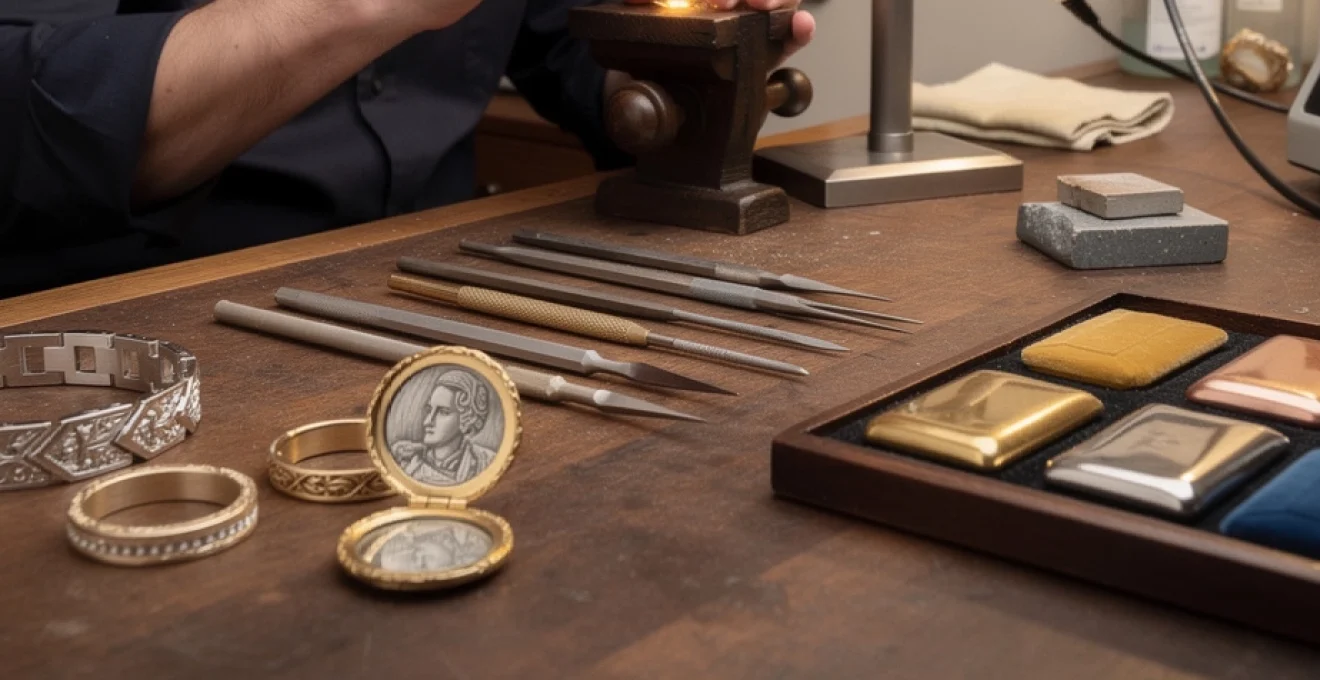
Hand engraved jewellery represents one of the most enduring and sophisticated forms of personal adornment, combining centuries-old craftsmanship with contemporary design sensibilities. This ancient art form transforms ordinary precious metals into extraordinary pieces that carry deep personal significance, whether through monograms, meaningful symbols, or intricate decorative patterns. The revival of traditional engraving techniques in modern jewellery making reflects a growing appreciation for artisanal quality and unique craftsmanship that cannot be replicated by machine production. Each hand engraved piece tells a story, capturing emotions and memories in permanent metal form that can be treasured for generations.
Traditional hand engraving techniques in contemporary jewellery craftsmanship
The art of hand engraving encompasses several distinct techniques, each offering unique aesthetic qualities and practical applications. Master engravers employ these methods to create everything from delicate script lettering to elaborate pictorial scenes, adapting traditional approaches to meet contemporary design requirements. Understanding these fundamental techniques provides insight into the complexity and skill required to produce exceptional hand engraved jewellery.
Bright cut engraving methods for precious metal surface detail
Bright cut engraving produces the most luminous and reflective surface finishes possible in hand engraving work. This technique involves making precise cuts at specific angles that create faceted surfaces reflecting light like tiny mirrors. The graver is held at approximately 45 degrees to the metal surface, creating bevelled cuts that catch and redirect ambient light. Bright cutting requires exceptional control and consistency, as even minor variations in angle or depth become immediately apparent in the finished work.
Contemporary jewellers often employ bright cut techniques around gemstone settings to enhance the overall brilliance of a piece. The reflective qualities of properly executed bright cuts can make diamonds appear larger and more luminous while adding visual interest to plain metal surfaces. This technique proves particularly effective on white gold and platinum pieces where the bright cuts create striking contrast against polished surfaces.
Relief engraving applications in Victorian-Style signet rings
Relief engraving involves removing background material to create raised designs that stand proud of the surrounding surface. This three-dimensional approach to engraving allows for incredibly detailed pictorial work and heraldic designs that were particularly popular during the Victorian era. Modern interpretations of relief engraving often incorporate family crests, personal symbols, or commemorative imagery that holds special significance for the wearer.
The process begins with careful planning and transfer of the design to the metal surface. Engravers then systematically remove material from background areas using various graver types, gradually building depth and creating the illusion of sculptural form. Relief engraving demands exceptional artistic skill as the engraver must understand principles of perspective, proportion, and light interaction to achieve convincing three-dimensional effects on a relatively shallow surface.
Wiggle work technique implementation on wedding band borders
Wiggle work creates distinctive wavy or zigzag patterns through controlled oscillation of the graver during cutting. This technique produces decorative borders and fill patterns that add texture and visual movement to otherwise plain surfaces. The rhythmic nature of wiggle work requires steady hands and consistent pressure to maintain uniform pattern density and depth throughout the design.
Wedding bands frequently feature wiggle work borders that complement central engravings or gemstone settings. The technique allows engravers to create sophisticated decorative elements without requiring extensive artistic drawing skills, making it accessible to craftspeople at various skill levels. Successful wiggle work relies on developing muscle memory through repeated practice until the oscillating motion becomes automatic and natural.
Bulino engraving mastery for portrait miniatures on lockets
Bulino engraving represents the pinnacle of artistic achievement in hand engraving, producing incredibly detailed portrait work using only linear techniques. This Italian-developed method relies entirely on line work to create tonal variations and dimensional effects, requiring extraordinary precision and artistic vision. Portrait miniatures engraved using bulino techniques can achieve photographic levels of detail and realism when executed by master craftspeople.
The technique employs specially prepared gravers with very fine points capable of creating lines as thin as human hair. Engravers build up images through careful layering of parallel lines, cross-hat
lines, and micro-dots, much like a painter uses tiny brushstrokes to build up shadows and highlights. Because every tonal change depends on the spacing and depth of these marks, bulino engraving is extremely time-consuming and demands absolute concentration. A single locket portrait can take many hours or even days to complete, with the engraver working under high magnification to ensure that every line contributes to the final likeness.
Modern jewellers often reserve bulino engraving for the most sentimental pieces: memorial lockets, family portraits, or miniature depictions of meaningful places. These portrait miniatures become wearable works of art, combining the intimacy of old master drawings with the durability of precious metal. For clients seeking a unique way to immortalise a loved one or commemorate a life event, a bulino-engraved locket offers an unparalleled level of emotional and artistic value.
Essential hand engraving tools and equipment selection
Behind every exquisitely engraved piece of jewellery lies a carefully chosen set of tools. While the principles of hand engraving have changed little over centuries, the equipment available to contemporary engravers has evolved significantly. Today’s craftspeople balance traditional hand tools with advanced pneumatic systems, selecting their equipment based on the desired engraving style, metal type, and production volume. Understanding the essential tools used in hand engraved jewellery helps clarify why artisanal work feels so different from mass-produced laser engraving.
At its core, hand engraving relies on three essential elements: the cutting tool (graver), the holding system (vise or block), and the sharpening setup. Around these, engravers add magnification, lighting, and sometimes pneumatic assistance to improve control and reduce fatigue. When all these components work harmoniously, the engraver can execute extremely precise cuts, consistent lettering, and complex decorative patterns that bring personalised jewellery to life.
GRS gravermeister pneumatic handpiece configuration
The introduction of pneumatic systems, such as the classic GRS Gravermeister and its modern successors, has transformed contemporary engraving practice. Rather than relying solely on hand pressure, the engraver uses a foot pedal or air control to drive a small piston inside the handpiece, delivering rapid, controlled impacts to the graver. This mechanism functions a little like a miniature jackhammer tuned for fine jewellery work, allowing for smoother, more consistent cuts, especially in harder metals like platinum or stainless steel.
Configuring a pneumatic handpiece for engraved jewellery requires careful adjustment of stroke speed, impact strength, and air pressure. Lower power settings suit delicate bright cutting and script lettering, while higher power helps when carving deep relief engraving or working on signet rings destined for daily wear. Many engravers maintain several interchangeable handpieces with different weight and geometry, choosing the one that best matches the scale of the design. For studio jewellers who produce a steady volume of personalised pieces, a well-configured pneumatic system can reduce hand strain and increase accuracy without sacrificing the authentic look of hand engraving.
Traditional graver steel selection: HSS versus carbide options
The graver itself remains the heart of engraved jewellery craftsmanship. Traditional carbon steel gravers were once the norm, but contemporary engravers typically choose between high-speed steel (HSS) and carbide, each offering distinct advantages. HSS gravers provide an excellent balance of toughness and edge retention, making them ideal for working on gold, silver, and softer platinum alloys. They are less brittle than carbide, so they tolerate minor misuse or accidental twisting without chipping as easily.
Carbide gravers, by contrast, excel in situations that demand extreme hardness and long-lasting edges, such as engraving stainless steel watch backs or titanium wedding bands. Their superior wear resistance means fewer sharpening interruptions during detailed projects, but they require more meticulous handling and a more precise sharpening routine. Many experienced engravers keep both HSS and carbide gravers at their bench, selecting the material based on each project’s metal substrate and the type of engraving—fine line work, deep cutting, or extensive shading.
Engraving block and ball vise setup for optimal control
Stability and control are essential for clean, elegant engraved lines, and this is where the engraving block or ball vise plays a crucial role. A heavy ball vise allows the engraver to rotate the workpiece smoothly while keeping it firmly clamped, enabling flowing curves and symmetrical scrolls with minimal repositioning. Think of it as the jeweller’s equivalent of a potter’s wheel: by turning the piece rather than the hand, the engraver maintains a comfortable working posture and more consistent stroke direction.
Setting up a ball vise correctly involves more than simply clamping the jewellery item. Engravers use thermoplastic fixturing compounds, shellac, or soft jaws to hold rings, pendants, and bangles securely without marring the metal. The height of the vise relative to the engraver’s eyes and hands is also critical, especially when working under a microscope or visor. A well-balanced setup reduces fatigue, improves line control, and ultimately leads to cleaner, more refined jewellery engravings that require less corrective polishing.
Sharpening stone grades for graver point maintenance
Even the finest graver material will perform poorly if its cutting edge is not perfectly sharpened and polished. Maintaining that edge is a continuous process in hand engraved jewellery; many engravers sharpen multiple times during a single project. Sharpening starts with coarse or medium stones to establish the geometry of the face and heel of the graver, then progresses through finer grades to refine and polish the cutting surfaces. Each step removes previous scratches and micro-chips, creating a clean, mirror-like edge capable of producing crisp, bright cuts.
Common sharpening systems combine diamond plates in various grits—such as 600, 1200, and 2000—with ceramic or Arkansas stones for final honing. Automated jigs help maintain precise angles, reducing variation between sharpenings and ensuring predictable cutting performance. For bright cut engraving, where the reflective quality of each facet is paramount, a highly polished graver tip is essential; any microscopic roughness will show up as dullness or drag lines in the finished jewellery. Regular, disciplined sharpening is therefore one of the most important habits an engraver can develop.
Premium metal substrates for hand engraved jewellery
The choice of metal substrate has a profound influence on both the visual impact and longevity of engraved jewellery. Different alloys respond uniquely to the graver, affecting line crispness, contrast, and wear resistance. When you run your finger across a beautifully engraved ring or pendant, the smoothness of the cuts and the sharp definition of the design are as much about the metal as about the engraver’s skill. Selecting the right precious metal is therefore a key part of planning any personalised engraving commission.
Sterling silver remains a favourite for hand engraved jewellery thanks to its relative softness, bright colour, and affordability. It allows for intricate detail and deep cuts, though it requires careful maintenance to prevent tarnish. Gold alloys—particularly 18ct yellow and rose gold—offer an ideal compromise between engravability and durability, giving warm, luxurious backgrounds for monograms, crests, and decorative borders. Platinum, with its exceptional density and strength, is more challenging to cut but rewards skilled engraving with sharply defined lines that resist wear over decades of daily use, making it a premium choice for heirloom wedding bands and engagement rings.
Personalisation techniques through custom monogram design
Custom monograms lie at the heart of engraved jewellery’s timeless appeal, transforming simple surfaces into highly personal statements. A monogram can be as minimal as a single initial or as elaborate as an interlaced three-letter cipher framed by scrollwork or heraldic motifs. The design process bridges graphic design and traditional calligraphy, translating the client’s initials into a balanced composition that fits the available space on a pendant, signet ring, or cufflink face. When executed by hand, each stroke captures subtle variations in depth and angle that give the monogram character and presence.
Developing a distinctive monogram begins with understanding the wearer’s style and the intended context. Are you looking for a bold, masculine engraving for a classic signet, or a delicate script monogram for a locket or bracelet charm? Engravers sketch multiple layouts, adjusting letter overlap, symmetry, and stroke weight until the design feels harmonious. In many workshops, these sketches are first explored on paper or digitally, then lightly transferred to the metal before cutting. This collaborative process ensures the final engraved jewellery piece not only reads clearly but also reflects the personality of its owner, turning simple initials into a lifelong signature.
Preservation methods for hand engraved heirloom pieces
Once an engraved piece has been painstakingly crafted, preserving its detail and brilliance becomes a priority. Hand engraved jewellery is often worn daily and passed down through generations, so it must withstand exposure to skin oils, cosmetics, cleaning agents, and environmental pollutants. Without proper preservation methods, fine lines can soften, oxidise, or become clogged with debris over time, dulling the design’s clarity. Fortunately, a combination of professional surface treatments and thoughtful at-home care can significantly extend the life and legibility of engraving.
Jewellers employ various protective finishes depending on the base metal and the client’s preferences, from rhodium plating on white gold to transparent lacquers on sterling silver. Equally important are routine cleaning habits and safe storage practices. Storing engraved pieces separately in soft-lined boxes, avoiding abrasive cloths, and scheduling periodic professional inspections are simple yet effective ways to ensure that engraved details remain as crisp as the day they were cut.
Rhodium plating applications for white gold engravings
White gold is a popular choice for contemporary engraved jewellery, particularly for wedding rings and pendants, yet its natural hue can lean slightly warm or grey depending on the alloy. Rhodium plating addresses this by adding a bright, cool-toned surface layer that enhances both colour and reflectivity. When applied over freshly engraved surfaces, rhodium can make bright cuts appear even more luminous and help fine line work stand out against the metal’s mirror finish. This is especially effective for engraved wedding bands, where subtle decorative borders benefit from increased contrast.
However, rhodium plating is not permanent; it gradually wears from high-contact areas, particularly on rings and bracelets. For engraved jewellery, this means a delicate balance is required. Excessive re-plating can slowly soften very shallow details if polishing is too aggressive beforehand. The most effective approach is to specify engravings with slightly greater depth on pieces destined for rhodium plating and to work with jewellers who use gentle, targeted refinishing techniques. With periodic maintenance every few years, white gold engravings can retain both their crispness and their bright white appearance.
Lacquer coating systems for sterling silver protection
Sterling silver’s tendency to tarnish is well known, yet its engravability and classic lustre keep it in high demand for personalised jewellery. Clear lacquer coating systems offer a way to preserve the fresh appearance of newly engraved silver by forming a transparent barrier against air, moisture, and sulphur compounds. When correctly applied, modern lacquers are thin enough not to obscure fine detail, allowing line work and bright cuts to remain visually sharp while significantly slowing down the tarnishing process.
Not every silver piece is an ideal candidate for lacquer, however. Items subjected to heavy wear or frequent contact with hard surfaces may experience localised coating breakdown, creating uneven patches that require professional stripping and reapplication. For engraved pendants, lockets, and earrings that experience gentler wear, lacquer coatings can be a practical preservation solution. Owners should still avoid harsh chemicals, ultrasonic cleaners, and abrasive cloths, as these can scratch the coating and compromise its protective function.
Professional cleaning protocols for intricate engraved details
Over time, even the best-protected engraved jewellery accumulates microscopic dirt and residue in its recesses, gradually dulling patterns and shading. While at-home cleaning methods can address light build-up, intricate engraved details are best maintained through periodic professional cleaning. Jewellers combine gentle ultrasonic baths, soft-bristle brushes, and non-abrasive polishing compounds to lift contaminants without eroding the fine cuts that define the design. This approach is particularly important for bulino portraits, scrollwork-filled signets, and deeply carved relief engravings where depth and contrast are crucial.
For daily care, simple habits go a long way: removing engraved rings before using strong household cleaners, applying perfume and lotions before putting on jewellery, and rinsing pieces in lukewarm water after exposure to salt or chlorinated water. When you notice that engraved lines look less distinct or that shadows appear muddy, it is a good sign that a professional assessment is due. By combining careful home maintenance with expert cleaning protocols every 1–2 years, you help ensure that engraved jewellery retains its original depth, sparkle, and legibility.
Market positioning of artisan hand engraved jewellery
In an era dominated by rapid production and digital personalisation, artisan hand engraved jewellery occupies a distinctive niche at the intersection of luxury, heritage, and emotional value. While laser engraving and mass-customisation platforms cater to speed and price sensitivity, hand engraving appeals to clients who prioritise craftsmanship, individuality, and long-term significance. This positioning is reinforced by growing consumer interest in slow fashion, sustainable practices, and traceable artisanal work, trends that are reshaping how people think about their jewellery collections.
From a market perspective, hand engraved pieces often function as anchor products within a brand’s offering, elevating perceived quality and attracting discerning customers who appreciate detail. Bespoke signet rings, heirloom-quality lockets, and custom-engraved wedding bands command higher price points not only because of the labour involved, but because they become irreplaceable symbols of identity, commitment, or remembrance. For independent jewellers and specialised ateliers, emphasising the narrative behind each piece—the hours of bench work, the traditional tools, the collaboration with the client—helps differentiate their work from mass-produced alternatives and fosters lasting client relationships.