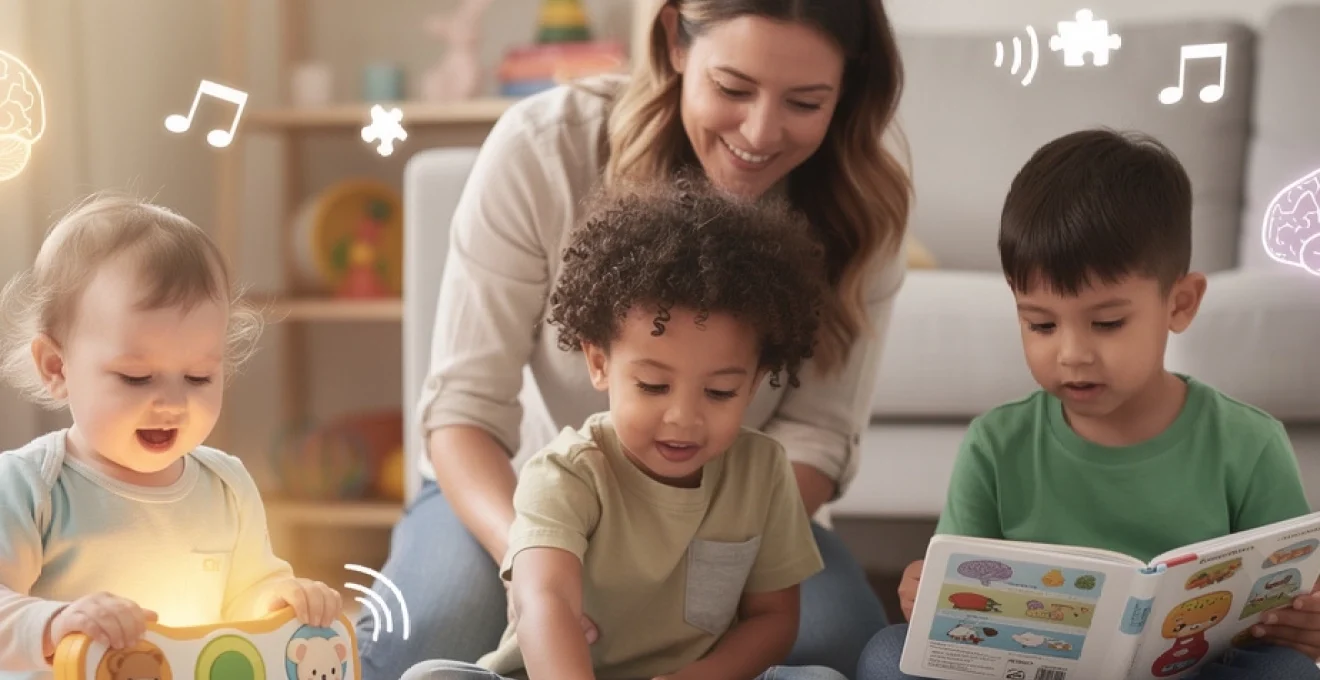
Sound books represent a revolutionary approach to early childhood education, seamlessly blending traditional storytelling with cutting-edge interactive technology. These innovative educational tools engage multiple senses simultaneously, creating rich learning environments that support cognitive development in ways that traditional books simply cannot match. Research consistently demonstrates that children who engage with sound books during their formative years develop stronger language skills, enhanced auditory processing abilities, and improved attention spans compared to those exposed solely to conventional reading materials.
The integration of auditory, visual, and tactile elements in modern sound books creates what educational psychologists term multisensory learning experiences. These experiences activate multiple neural pathways simultaneously, strengthening memory formation and recall whilst making learning inherently enjoyable for young minds. As parents and educators seek more effective methods to support early childhood development, sound books emerge as powerful tools that transform passive reading into active, engaging adventures that captivate children’s imagination whilst building essential literacy foundations.
Neurological development through auditory learning mechanisms
The human brain undergoes remarkable transformation during the first five years of life, with neural connections forming at an astonishing rate of over one million per second. Sound books capitalise on this critical developmental window by providing structured auditory input that directly supports brain architecture development. When children engage with these interactive learning tools, specific regions of the brain responsible for language processing, auditory discrimination, and executive function become increasingly active and interconnected.
Modern neuroscience reveals that auditory learning activates the temporal lobe, Broca’s area, and Wernicke’s area simultaneously, creating robust neural networks that support both receptive and expressive language skills. This cross-modal plasticity enables children to develop stronger communication abilities whilst enhancing their capacity to process complex information across multiple sensory channels. The rhythmic patterns and melodic elements found in quality sound books further stimulate the cerebellum, which plays a crucial role in motor coordination and cognitive processing.
Phonemic awareness enhancement via sound book narration
Phonemic awareness, the ability to identify and manipulate individual sound units within spoken words, forms the cornerstone of successful reading development. Sound books excel at developing this critical skill through precise, repetitive exposure to phonetic patterns embedded within engaging narratives. Professional narration in high-quality sound books provides children with clear models of correct pronunciation, intonation, and rhythm, enabling them to internalise the subtle nuances of spoken language naturally.
The repetitive nature of sound book interactions creates multiple opportunities for children to hear and process the same phonetic elements in various contexts. This distributed practice approach proves far more effective than traditional drilling methods, as children remain engaged and motivated throughout the learning process. Research indicates that children who regularly interact with sound books demonstrate significantly improved phonemic awareness scores compared to their peers who rely solely on traditional reading instruction.
Temporal processing skills development through audio sequencing
Temporal processing, the ability to perceive and understand the order and timing of auditory information, represents a fundamental skill underlying successful language acquisition and reading comprehension. Sound books naturally develop these abilities by presenting carefully sequenced audio content that requires children to follow complex narrative structures whilst maintaining attention to temporal relationships between events.
The interactive nature of sound books enables children to control the pace of information delivery, repeatedly accessing audio segments until they fully comprehend the sequence of events. This self-paced learning approach accommodates individual processing speeds whilst building confidence in auditory comprehension. Children develop sophisticated auditory sequencing abilities as they learn to predict narrative outcomes, recall story elements in correct order, and understand cause-and-effect relationships within complex storylines.
Working memory strengthening using interactive sound elements
Working memory, often described as the brain’s mental workspace, enables children to hold and manipulate information whilst performing cognitive tasks. Sound books provide exceptional opportunities to strengthen working memory capacity through carefully designed interactive elements that require simultaneous processing of auditory, visual, and tactile information. As children navigate through sound book activities, they must remember previous story elements whilst processing new information and planning their next actions.
The multi-step interactions common in advanced sound books challenge children to maintain multiple pieces of information in their working memory simultaneously. This cognitive exercise strengthens the neural networks responsible for executive function, attention control, and information processing. Studies demonstrate that children who regularly engage with interactive sound books show measurable improvements in working memory
Studies demonstrate that children who regularly engage with interactive sound books show measurable improvements in working memory, particularly in tasks that require holding story details in mind while answering questions or predicting what comes next. Over time, this repeated mental practice translates into better performance in classroom activities such as following multi-step instructions, solving early maths problems, and engaging in extended conversations. In this way, the simple act of pressing buttons and listening to sounds becomes a powerful workout for the developing brain’s “mental notepad.”
Language acquisition acceleration through prosodic pattern recognition
Beyond individual sounds, young children must also master prosody—the rhythm, stress, and intonation patterns of speech—to become confident communicators. Sound books are uniquely positioned to accelerate language acquisition because they present speech with exaggerated, child-friendly prosodic contours. Narrators often use sing-song tones, clear pauses, and expressive emphasis, making it easier for children to decode where words begin and end, and how sentences are organised.
When children repeatedly hear stories, nursery rhymes, and songs through sound book narration, they begin to internalise these prosodic patterns. This supports more natural speech production, better understanding of questions versus statements, and early grasp of sentence structure. Prosody also carries emotional information, so listening to expressive voices helps children interpret feelings such as excitement, surprise, or sadness, which in turn supports social communication skills. In essence, sound books provide a rich prosodic environment that mirrors the benefits of being read to by an expert storyteller every day.
Multi-sensory learning integration in modern sound book technology
Modern sound books for toddlers and preschoolers do far more than play simple tunes; they integrate sophisticated multi-sensory learning experiences that combine touch, sight, and sound. Educational technology companies have harnessed research on multisensory instruction to design products that keep children engaged while reinforcing key early learning concepts. When children tap, slide, or turn components while hearing associated sounds or words, they create strong associations that support deeper understanding and long-term memory.
These multi-sensory sound books also respect the reality of short attention spans in early childhood. By offering multiple modes of interaction on each page, such as textured surfaces, light-up features, and responsive narration, they invite children to explore and revisit content from different angles. This variety reduces boredom and encourages sustained engagement, which is crucial for building early literacy and numeracy skills through repeated practice that still feels like play.
Tactile feedback systems in LeapFrog and VTech sound books
Brands like LeapFrog and VTech have become well-known for integrating tactile feedback systems into their interactive sound books. Children can press raised buttons, trace textured letters, or manipulate sliders that click into place, all of which provide immediate physical feedback. This combination of fine motor practice and auditory output helps solidify associations between letter shapes, spoken sounds, and meanings, supporting pre-writing skills and early phonics learning.
For example, when a child runs a finger along a textured “A” and hears the corresponding /a/ sound or a word like “apple,” multiple sensory channels are activated simultaneously. This is similar to constructing a sturdy bridge: each additional support beam (touch, sound, sight) makes the structure stronger. Tactile feedback systems also help children who are kinesthetic learners, as the physical actions of pushing and turning become part of the learning process rather than a distraction from it.
Visual-auditory synchronisation in melissa & doug musical books
Melissa & Doug musical books focus heavily on the synchronisation of visual and auditory cues to support early learning. When a child taps a picture of a piano and hears a piano sound, or sees an image of a farm animal while hearing its call, the brain quickly learns to connect symbol and sound. This visual-auditory synchronisation is particularly powerful for building vocabulary and categorisation skills, as children start to group related sounds and images together.
The clear, uncluttered artwork found in many Melissa & Doug musical books reduces unnecessary visual noise, allowing young learners to focus on the core learning targets. Bright colours and simple shapes guide attention, while matching sound effects reinforce the meaning of each image. Over time, children learn to infer meaning from pictures even before they can read, laying the groundwork for later comprehension skills in traditional print books.
Haptic response technology in Fisher-Price laugh & learn series
Fisher-Price’s Laugh & Learn series takes multisensory integration a step further with haptic response technology. Some sound books and interactive pages in this range provide subtle vibrations or mechanical feedback when children activate certain features. These haptic responses act like a gentle “tap on the shoulder,” confirming that an action has been recognised and encouraging further exploration.
For young children still learning cause and effect, this feedback loop is invaluable. When they press a picture and feel a slight vibration along with hearing a sound or phrase, they quickly understand that their actions produce predictable outcomes. This supports not only cognitive development but also emotional regulation, as consistent, reliable feedback helps children feel in control of their environment. In early learning, such small but meaningful successes can significantly boost motivation and confidence.
Interactive Touch-Sensitive pages in national geographic kids explorer books
National Geographic Kids Explorer sound books combine high-quality photography with touch-sensitive pages that respond to children’s exploration. Instead of isolated buttons, entire sections of a page can be interactive, enabling more natural, curiosity-driven discovery. A child might touch a rainforest leaf to hear dripping water, or tap an animal to hear its call while viewing a real-world image.
This style of interaction encourages children to think like young scientists: they observe, hypothesise (“What will happen if I touch here?”), and then test their ideas. The rich combination of realistic imagery and accurate soundscapes also supports early science learning, as children start to link habitats, animals, and environmental sounds. For many families, these Explorer sound books become gateways into broader conversations about the natural world, conservation, and geography.
Cognitive load theory applications in sound book design
Cognitive Load Theory suggests that learners have a limited capacity for processing new information at any given time. Well-designed sound books take this into account by balancing engagement with simplicity, ensuring that children are challenged but not overwhelmed. For example, the best early learning sound books avoid playing multiple overlapping sounds or presenting overly complex visuals on a single page, which could overload a child’s working memory.
Instead, thoughtful design focuses on germane cognitive load—the mental effort that directly contributes to learning. A sound book might introduce one new concept per page, such as a single letter sound or animal name, and use supportive audio cues to reinforce it. By minimising extraneous distractions, these books help children allocate their cognitive resources to the most important elements. Parents can further apply Cognitive Load Theory by introducing new sound books slowly, revisiting familiar titles often, and pausing to discuss content rather than racing through pages.
Age-appropriate sound book selection frameworks
Selecting the right sound book for your child’s developmental stage is essential to maximise both educational impact and enjoyment. While it can be tempting to choose the most advanced-looking interactive book, research shows that children learn best when materials are just slightly above their current skill level. This “zone of proximal development” keeps content challenging enough to be interesting, yet not so difficult that it leads to frustration.
By understanding typical language and cognitive milestones for different age bands, parents and educators can build a sound book collection that grows with the child. The following frameworks outline key considerations for each stage, from early pre-literacy to the beginning of formal reading. You can use them as a guide when shopping for sound books online or evaluating titles already on your shelves.
Pre-literacy stage requirements for 6-18 month learners
For babies between 6 and 18 months, the primary goal of interactive sound books is exposure and enjoyment rather than explicit teaching. At this stage, simple cause-and-effect experiences—pressing a button to hear a lullaby or animal noise—are ideal. Sturdy board books with rounded corners, large buttons, and limited sound options help prevent overstimulation while supporting safe exploration.
Language input should focus on familiar, everyday words such as “mama,” “dog,” “ball,” and basic environmental sounds. Short melodies and rhythmic patterns are especially effective, as infants are naturally attuned to musical prosody. Parents can enhance learning by naming pictures aloud, mirroring the sounds, and pausing to let the baby respond with gestures, babbles, or smiles. During this pre-literacy stage, the sound book becomes a shared experience that builds bonding as well as early listening skills.
Emergent reading phase considerations for toddlers aged 18-36 months
Between 18 and 36 months, toddlers enter the emergent reading phase, where they begin to recognise pictures, follow simple storylines, and repeat favourite phrases. Sound books for this age group can introduce more structured content, such as short songs with clear refrains, simple counting sequences, or basic alphabet exposure. Interactive features like lift-the-flap elements combined with sound can add an extra layer of curiosity and engagement.
Because toddlers are rapidly expanding their vocabularies, sound books that label common objects, actions, and emotions can be particularly beneficial. You might choose titles that ask simple questions (“Where is the cat?”) or invite participation (“Can you roar like the lion?”). These prompts encourage active listening and verbal imitation, both crucial precursors to later reading success. Keeping sentences short and repeating key words across pages helps toddlers consolidate new language without overloading their still-developing processing systems.
Early reading development support for 3-5 year age groups
Preschoolers aged 3 to 5 years are ready for more sophisticated sound books that support early reading development directly. At this stage, you can introduce phonics-based titles that link individual letters or letter groups with their corresponding sounds. Some sound books allow children to tap a letter and hear its sound, then listen to it within a word, helping them understand how letters combine to form spoken language.
Story-based sound books with longer narratives, multiple characters, and clear plot structures also become valuable tools. Features such as “read-along” modes, where each word is highlighted on the page as it is spoken, bridge the gap between listening and independent reading. Preschoolers can be encouraged to predict what will happen next in the story, retell events in their own words, and even “read” favourite lines from memory, all of which build comprehension and narrative skills essential for school readiness.
Educational psychology principles behind interactive audio learning
Interactive audio learning in sound books draws on several well-established principles from educational psychology. One key idea is dual coding theory, which states that information is more easily remembered when it is presented through both verbal and non-verbal channels. In a sound book, spoken words and sound effects (verbal) are paired with pictures and symbols (non-verbal), creating two complementary memory traces. This is much like backing up a file in two locations; if one pathway is weak, the other can support recall.
Another important principle is self-determination theory, which emphasises the role of autonomy, competence, and relatedness in motivation. Sound books support autonomy by letting children control when and how they activate sounds, competence by providing immediate positive feedback when buttons are pressed correctly, and relatedness through shared reading time with adults. When children feel in control, successful, and emotionally connected, they are far more likely to engage deeply with early learning activities.
Finally, interactive sound books naturally incorporate scaffolding, a concept derived from Vygotsky’s work on social learning. Many titles are structured so that children can start with simple sound identification and gradually move toward more complex tasks, such as answering comprehension questions or following multi-step directions. Parents and educators can add additional layers of support—such as modelling answers or expanding on a child’s comment—then slowly withdraw help as the child becomes more confident. In this way, the combination of technology and human interaction creates an optimally supportive learning environment.
Comparative analysis of traditional print versus digital sound book platforms
As sound books evolve from battery-powered board books to app-based platforms and e-readers with audio, many caregivers wonder how these formats compare to traditional print. Traditional print books excel at fostering imagination, as children must mentally supply voices, soundscapes, and emotional tone. They also encourage deep focus, with fewer built-in distractions, and are often easier to share in group settings like classrooms or libraries without the need for electronic components.
Digital sound book platforms, on the other hand, offer robust support for early literacy, especially for children who are still developing decoding skills. Built-in narration, tap-to-hear word features, and adaptive difficulty levels make stories accessible to a wider range of learners, including those with reading difficulties or emerging bilingual skills. For families with limited time to read aloud, digital sound books can help ensure children still receive rich auditory language input daily. However, they require thoughtful use: adults should monitor screen time, choose ad-free or child-safe apps, and continue to participate actively in digital reading rather than leaving children alone with devices.
In practice, the most effective early learning environments use a blend of traditional print and digital sound books. Print titles can be used for quiet, imaginative reading and tactile exploration, while sound-enabled platforms provide targeted support for pronunciation, comprehension, and engagement. When you view these formats not as competitors but as complementary tools, you can create a rich, varied reading ecosystem that leverages the strengths of each to support your child’s development.